Gitanjali
Song Offerings

Introduction
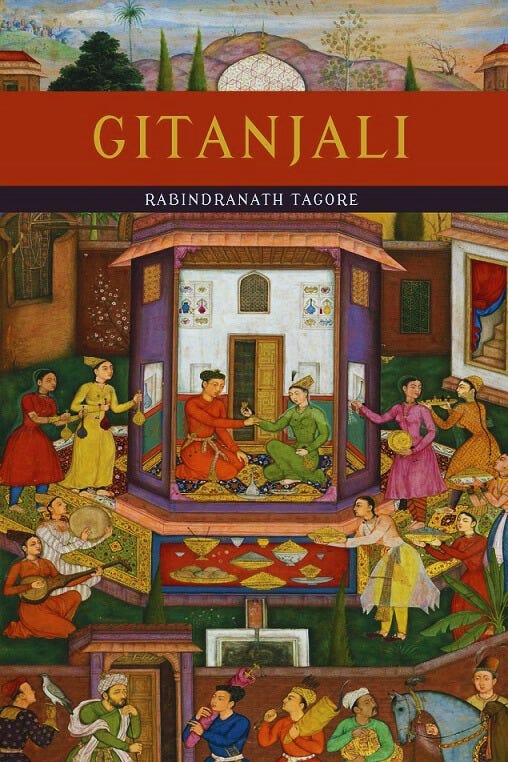
"Gitanjali," Song Offerings, is a timeless collection of spiritual and devotional poetry by Rabindranath Tagore, first published in 1913. Written originally in Bengali and later translated into English by the poet himself, the collection earned Tagore the Nobel Prize for Literature in 1913, making him the first non-European laureate. The poems are steeped in themes of spirituality, divine love, nature, and human connection. With an introduction by W.B. Yeats, the collection gained international recognition for its lyrical beauty and universal appeal.
Book Details
Author: Rabindranath Tagore
Original Language: Bengali
Translated By: Rabindranath Tagore
Published: 1913
Genre: Poetry, Spirituality
Notable Recognition: Nobel Prize in Literature (1913)
Themes
Union with the Divine: A central theme in Gitanjali is the poet’s deep longing to merge with the divine, portrayed as a loving and omnipresent entity. This union is not just a mystical desire but also an intimate, personal yearning, akin to the love between a devotee and their deity or a lover and their beloved. The divine is addressed in intimate terms, such as "Thy" (your) and "Thou" (you), reflecting both reverence and closeness. "I know not how thou singest, my master! I ever listen in silent amazement. The life breath of thy music runs from sky to sky." (Master: God; Thou: you; Thy: your; life breath: vitality that pervades all creation.) This verse captures the poet’s awe at the divine's omnipresence and its expression through nature’s music and rhythms.
Nature as a Divine Manifestation: Nature in Gitanjali is not separate from God but a vivid reflection of the divine’s beauty and love. Rivers, flowers, light, and seasons symbolize God's eternal presence, with each element narrating its own song of creation. The poet celebrates this interconnectedness, showing how humanity and the natural world are entwined. "The same stream of life that runs through my veins night and day runs through the world and dances in rhythmic measures."
(Stream of life: the universal flow of vitality shared by all beings; rhythmic measures: the harmony of creation.) Through this, Tagore portrays life as a divine dance, where every being is a participant in God’s melody.
Life’s Journey and Mortality: Tagore explores the transient nature of life, likening it to fleeting songs, setting suns, or passing seasons. While acknowledging mortality, he emphasizes that life’s impermanence is part of its beauty. The journey of life is seen as preparation for the ultimate union with the divine. "The song that I came to sing remains unsung to this day. I have spent my days in stringing and in unstringing my instrument." (Unsung: unrealized potential; instrument: metaphor for life or human capability.) This reflects a sense of incompleteness, where life is an ongoing quest, and fulfillment lies in divine acceptance.
Inner Purity and Devotion: The poet underscores the importance of inner simplicity, humility, and devotion as paths to spiritual awakening. Material possessions and pride are depicted as barriers, whereas purity of thought and heart open the way to divine grace. "My poet's vanity dies in shame before thy sight. O master poet, I have sat down at thy feet." (Vanity: excessive pride; Thy: your; Master poet: God as the ultimate creator.) Here, Tagore humbles himself before God, surrendering personal pride in recognition of divine supremacy.
Celebration of Creation: Tagore finds joy in the mundane and extraordinary aspects of life, celebrating the Creator’s hand in all things. His verses speak of delight in beauty, in love, and in the everyday experiences that connect humans to the divine. "Light, my light, the world-filling light, the eye-kissing light, heart-sweetening light!". (Light: divine presence or enlightenment; heart-sweetening: bringing joy and fulfillment to the heart.) The poet paints light as a metaphor for God’s blessings, bringing joy and clarity to existence.
Quotes
"Thou (you) hast (have) made me endless, such is thy (your) pleasure. This frail (weak) vessel thou (you) emptiest again and again, and fillest it ever with fresh life."
"Deliverance (Liberation or salvation) is not for me in renunciation (rejecting something). I feel the embrace (accepting) of freedom in a thousand bonds of delight (joy)."
"Where the mind is without fear and the head is held high; Where knowledge is free..."
"The same stream of life that runs through my veins night and day runs through the world and dances in rhythmic measures (symbolizing harmony in nature)."
"Leave this chanting and singing and telling of beads! Whom dost (do) thou (you) worship in this lonely dark corner of a temple with doors all shut? Open thine (your) eyes and see thy God is not before thee (you)!"
"My song has put off her adornments (Decorations). She has no pride of dress and decoration. Ornaments would mar (to spoil) our union; they would come between thee (you) and me; their jingling (metallic sound) would drown thy whispers (quiet speech)."
"I know thou (you) takest pleasure in my singing. I know that only as a singer I come before thy (your) presence."
"I shall ever try to keep my body pure, knowing that thy living touch is upon all my limbs."
"I shall ever try to keep all untruths out from my thoughts, knowing that thou art that truth which has kindled (ignited) the light of reason in my mind."
"The time that my journey takes is long and the way of it long. I came out on the chariot of the first gleam (brief light) of light, and pursued my voyage through the wildernesses of worlds leaving my track on many a star and planet."
"I have not seen his face, nor have I listened to his voice; only I have heard his gentle footsteps from the road before my house."
"I keep gazing on the far-away gloom (sadness) of the sky, and my heart wanders (moves aimlessly) wailing (mournful cry) with the restless wind."
"Thy desire at once puts out the light from the lamp it touches with its breath. It is unholy—take not thy gifts through its unclean hands."
"The blossom has not opened; only the wind is sighing by."
"O Fool, try to carry thyself upon thy own shoulders! O beggar, to come beg at thy own door!"
"Every morning at three—I know, for I have seen it—one said to me, 'he sits immovable in contemplation, and for two hours does not awake from his reverie (Daydream or musing) upon the nature of God.'"
Overall Impression
"Gitanjali" is a masterpiece of devotional poetry that transcends cultural and linguistic barriers. Its lyrical beauty and spiritual depth make it a timeless work that resonates with readers across generations. Through simple yet profound verses, Tagore explores universal themes of love, devotion, and human connection. The poems’ meditative tone encourages reflection, and their vivid imagery immerses readers in a spiritual journey. The use of archaic language like Thy and Thou adds a timeless, sacred quality, making it a deeply enriching experience.